
Planets♥…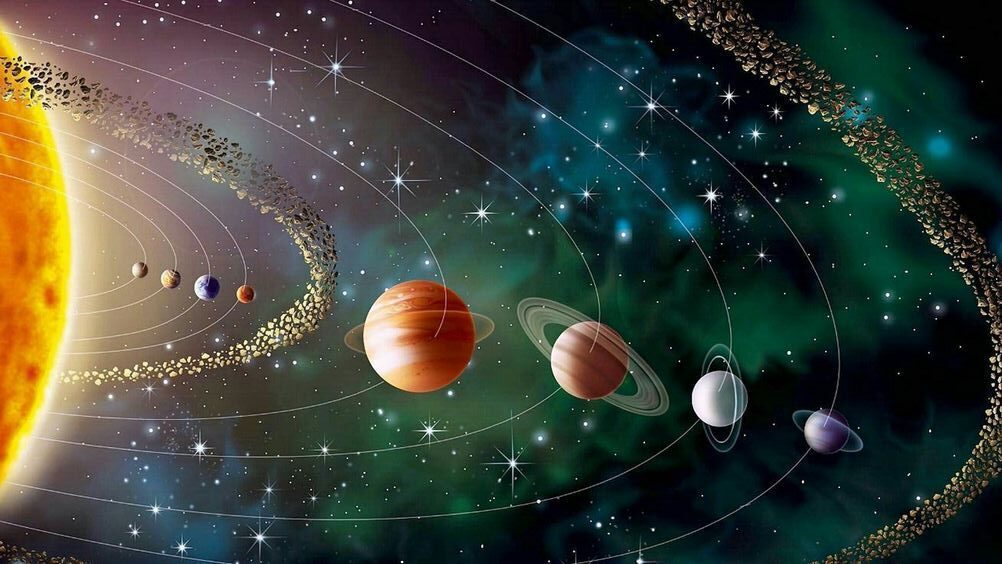
EARTH⇒
Every year on 22 April, we’ve celebrated Earth Day and the beautiful planet we call home. Earth Day, established in 1970, has been used to highlight our planet’s environmental challenges and raise awareness of the importance of protecting our world for future generations. But shouldn’t every day be Earth Day? We only have one beautiful planet after all. We hope you enjoy this curated list of 10 f the most remarkable facts about Earth.
1. Earth isn’t actually round
While this sounds like an elaborate joke, we’re actually serious. Earth isn’t flat, but it’s not perfectly round either. Earth’s rotation causes the planet to bulge at the equator and flatten at the poles, while the distribution of mass on Earth (which is not perfectly uniform) causes small variations in the gravitational pull at different locations on the planet. These variations are too small to be seen in pictures of Earth from space, so it appears round to the human eye
2. Coral reefs are Earth’s largest living structure
Coral reefs are not only beautiful natural wonders, but also the largest living structure on Earth. These underwater ecosystems are made up of colonies of tiny animals called coral polyps, which build calcium carbonate skeletons that accumulate over time and form the complex structures we know as coral reefs.
Coral reefs are incredibly diverse and play a vital role in the ocean ecosystem, providing habitat and protection for many species, and acting as a natural barrier that helps to protect coastlines from storms and erosion.
3. Earth has a squishy interior
Earth’s interior is not solid, but rather has a semi-solid or ‘squishy’ consistency owing to high temperatures and pressures. This squishy consistency allows the mantle to flow and move over geological timescales, which is responsible for phenomena such as plate tectonics, volcanic activity and earthquakes.
One consequence of this squishy interior is a process known as post-glacial rebound. During the last ice age, large portions of Earth’s surface were covered by glaciers, causing the underlying mantle to deform and sink. As the glaciers melted and receded, the mantle slowly rebounded back to its original position over thousands of years, causing the land above it to rise.
4. Antarctica is home to the largest ice sheet on Earth
More than six times as large as Greenland, Antarctica is the southernmost continent and is the coldest and windiest place on Earth – with temperatures that can drop as low as -89.2°C and winds that can exceed 320 km per hour.
Antarctica is home to the largest ice sheet on Earth, containing a staggering 30 million cubic kilometres of ice. This represents an incredible 70% of Earth’s freshwater and 90% of its ice. As a result, changes to the Antarctic ice sheet can have significant implications for global sea levels and ocean currents.
5. The Moon is drifting away from Earth
You read that correctly! The Moon is gradually drifting away from Earth at a rate of approximately 4 cm per year. This phenomenon is caused by the Moon pulling on Earth’s oceans creating tidal forces that produce a bulge of water on the side of Earth facing the Moon.
This bulge in turn creates a gravitational pull on the Moon, causing it to accelerate slightly and move further away from Earth. Over time, this process has caused the Moon to move farther away from Earth each year. This gradual drift is not noticeable on a day-to-day basis, but over millions of years, it can have significant effects on Earth’s rotation.
6. Atacama is the driest place on Earth
The Atacama Desert, located in South America, is widely considered to be the driest place on Earth, outside of the Antarctic dry valleys. This vast expanse of land spans over 100 000 sq km and receives an average of less than 1 mm of rainfall per year.
Atacama Desert
The harsh climate of the Atacama is due to a combination of factors including its location in a rain shadow caused by the Andes mountains, the presence of the cold Humboldt Current offshore and a lack of moisture-bearing winds.
7. Earth’s magnetic pole is creeping westward
Unlike our geographic North Pole, which is in a fixed location, Earth’s magnetic north wanders. Until the early 1990s, the magnetic North Pole was known to lie some 1600 km south of true north, in Canada. Yet scientists realised that the location of magnetic north wasn’t fixed and was drifting at a rate of 15 km a year. Since the 1990s, however, the drift of Earth’s magnetic pole has turned into more of a sprint.
8. Europe is the second smallest continent in size but the third largest in population
Europe is known for its diverse cultures, rich history and stunning landmarks. Despite being the second smallest continent in size (after Australia), Europe is home to a staggering population of over 746 million people, making it the third largest continent in terms of population (after Asia and Africa).
Europe has one of the highest levels of urbanisation in the world, with over 75% of its population living in urban areas. With the world’s population expected to reach 9.7 billion in 2050, we must increase efforts to understand and mitigate the challenges brought by rapid and unplanned urbanisation, air pollution, as well as issues related to the management of water and energy.
9. Tibetan plateau is Earth’s ‘third pole’
The Tibetan Plateau is often referred to as the ‘third pole’ owing to the amount of freshwater it contains. With over 46 000 glaciers, the Tibetan Plateau holds the largest reserve of freshwater outside of the North and South Poles.
These glaciers feed the rivers that run through the region, including the Mekong, Yangtze, and Yellow River, providing a vital source of water for millions of people in China and Southeast Asia.
The Tibetan Plateau’s glaciers, along with other glaciers around the world, are under threat from climate change. Rising temperatures are causing the glaciers to melt at an unprecedented rate, which could have devastating consequences for the people and ecosystems that depend on them.
10. Trees are breathers
Trees are one of the most effective tools we have to combat climate change. Forests are home to around 80% of biodiversity on land and tropical forests alone produce over 40% of the oxygen we breathe.
Covering around 30% of Earth’s land surface, we depend on forests for our survival. Forests absorb around 8 Gigatonnes a year of carbon dioxide from the atmosphere and play a crucial role in the carbon cycle and climate system.
However, climate change, forest degradation and deforestation are causing much of this stored carbon to be released back into the atmosphere. Recent research found that recovering tropical forests were only successfully combatting a quarter of the current carbon emissions and indicates the importance of preserving and restoring our tropical forests.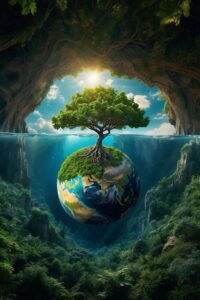
THE MOON EARTH’S NATURAL SATELLITE
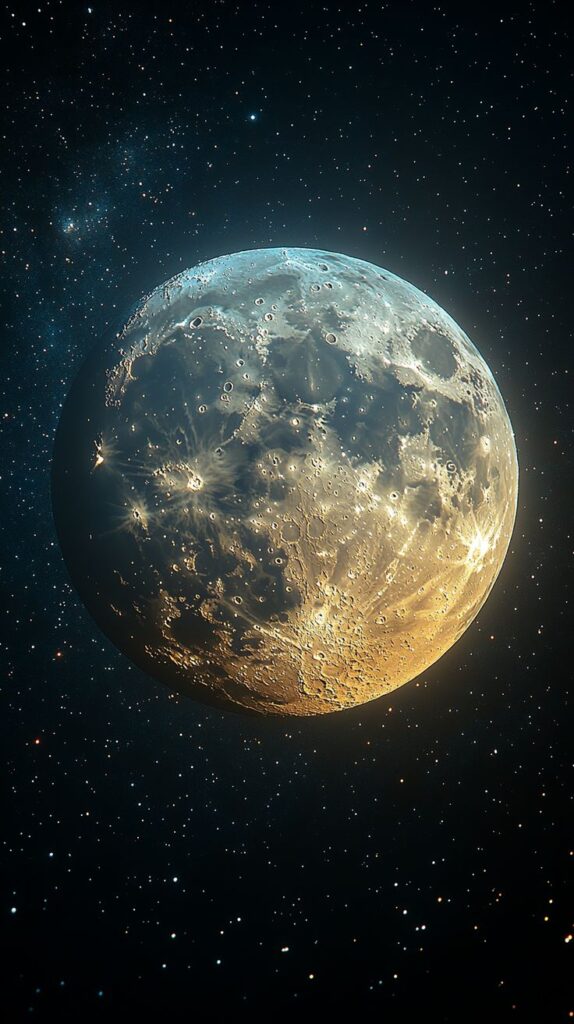
The Moon is the Planet Earth’s only natural satellite. This means that it is the only satellite not put into Earth’s orbit by humankind. Planets can have more than one moon. For example, Jupiter has 79 known moons orbiting it. Planet Earth just has one moon that often goes by the name of “Luna.” The Moon is located approximately 384,633 km away from Earth, and has a diameter that is just 1/81 of Earth’s diameter. This may sound tiny, but it makes it the largest moon in the solar system relative to the size of the planet that it orbits. Humankind visited the Moon for the first time in 1969 with the Apollo missions and now, fifty years later, there are plans to return with the Artemis missions.
How was the Moon formed?
There are a variety of hypotheses about how the Moon was formed. The most widely accepted hypothesis suggests that another astronomical body, similar to the size of Mars, collided with the Earth in the early days of its formation. The body that the Earth collided with has been named Theia. It is proposed that the collision led to rock and dust being ejected into Earth’s orbit. This rock and dust likely then coalesced to form the Moon, in a similar way to how the dust and gaseous material of the Solar Nebula formed the planets of the solar system.